
Trogir
Uvala Duga Čiovo
Kljuda
Blue Lagoon Drvenik
Island of Solta (Maslenica)
Vinišće Jelinak Bay (Underwater Stations of the Cross)
Trogir

Excursions
Trogir
Uvala Duga Čiovo
Kljuda
Blue Lagoon Drvenik
Island of Solta (Maslenica)
Vinišće Jelinak Bay (Underwater Stations of the Cross)
Trogir
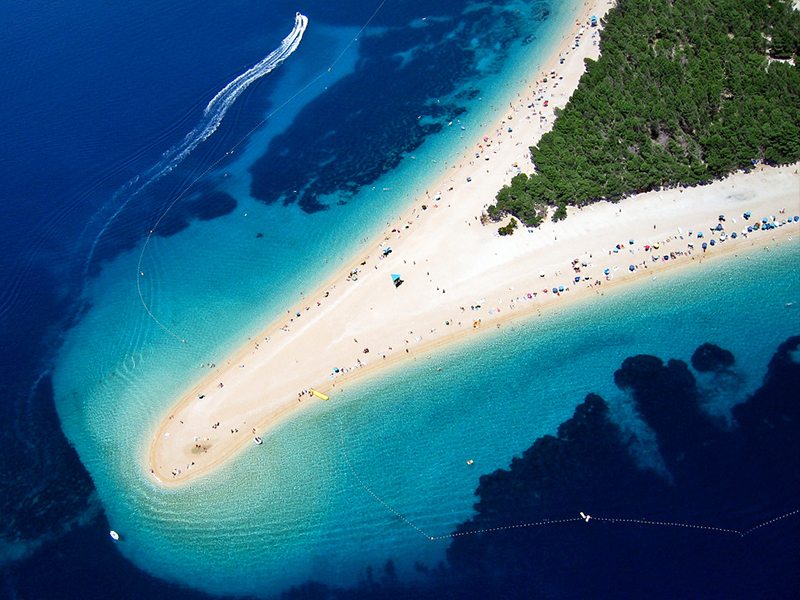
Brač is an island in the Adriatic Sea within Croatia, with an area of 396 square kilometres (153 sq mi), making it the largest island in Dalmatia, and the third largest in the Adriatic. It is separated from the mainland by the Brač Channel, which is 5 to 13 km (3 to 8 mi) wide. The island’s tallest peak, Vidova gora, or Mount St. Vid, stands at 780 m, making it the highest island point in the Adriatic. The island has a population of 13,956, living in numerous settlements, ranging from the main town Supetar, with more than 3,300 inhabitants, to Murvica, where less than two dozen people live. Bol Airport on Brač is the largest airport of all islands surrounding Split. The Zlatni Rat, often referred to as the Golden Cape or Golden Horn, is a spit of land located about 2 kilometres west from the harbour town of Bol on the southern coast of the Croatian island of Brač, in the region of Dalmatia.
Bol is situated on the southern part of the island Brac, and is the oldest town on the coast of Brac. This little town was founded long ago and became an extraordinary tourist oasis because of the wide gravel and sandy beaches which expands over 10 km and the sources of drinking water.
Above Bol is rising the coronet of Bols hills, the illlyrian fortress Kostilo (660 m) and the Vidova gora (778 m), the highest top of the Adriatic islands. Bol is only 15 km away from the international tourist and sports airport “Brac”, and excellent connected with the fast lines to the coast, but also with a ferry- line from Supetar.
Place to see – Beach Zlatni rat
It is not possible to avoid the Zlatni rat, certainly the most beautiful beach on the Adriatic sea, whose cape is turning one moment to one side and the other moment to the other side playing a strange game with the wind and the waves.
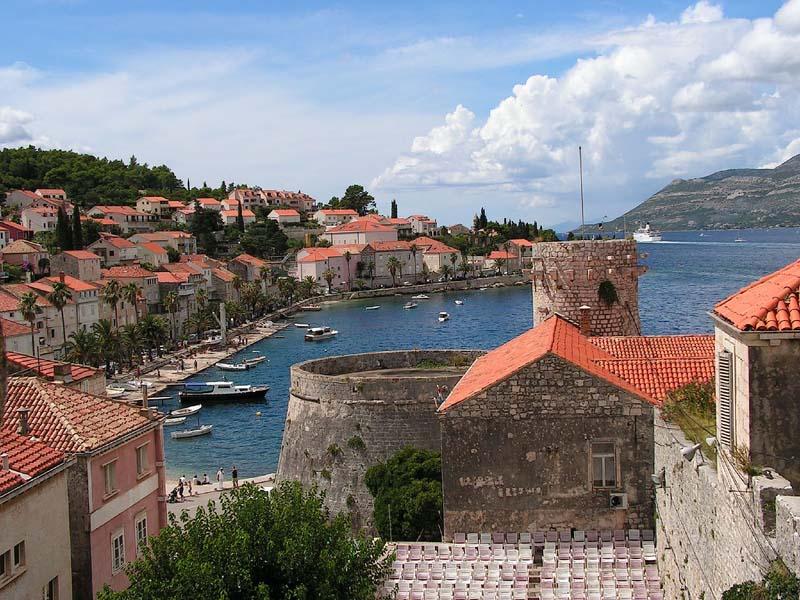
This small village with the most breathtaking sunset is located on the west side of Šolta. Archipelago of seven small islands (Polebrnjak, Saskinja, Stipanska, Kamik, Balkun, Šarac and Grmej) is just one of many things that make Maslinica one of the most beautiful places on the Adriatic coast. Restoration of the castle into a hotel and the construction of a nautical marina are turning this village little by little into the tourist centre of the island that greets more and more guests each year. Apart from Maslinica, the boaters find the neighbouring bay, Šešula, with its safe anchorage and unique gastronomical experience very attractive. During the year, Maslinica has about 200 permanent residents, but during the summer the number grows, and its accommodation’s capacity is about 400 guests.
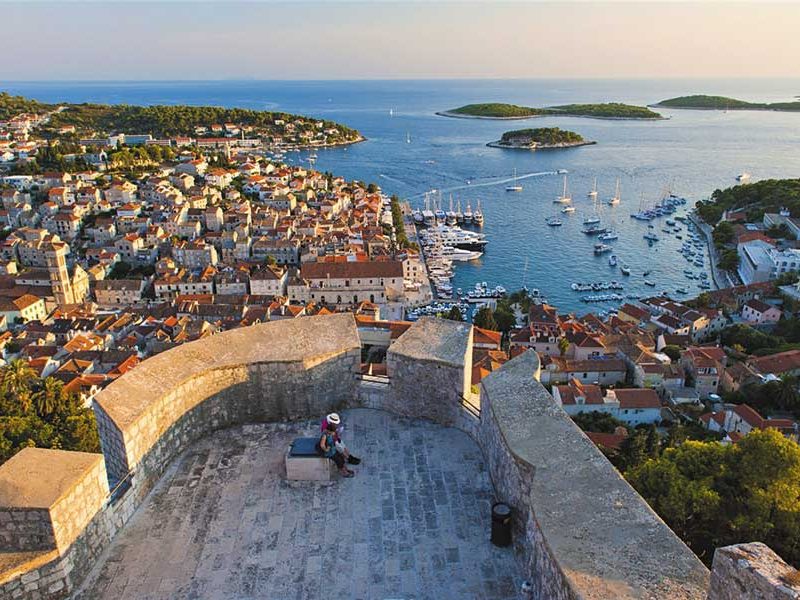
Hvar, a Croatian island in the Adriatic Sea, is best known as a summer resort. Highlights of the port town Hvar include its 13th-century walls, a hilltop fortress and a main square anchored by the Renaissance-era Hvar Cathedral. The island also features beaches such as Dubovica and inland lavender fields. Boat excursions serve the nearby Pakleni Islands, which have secluded beaches and coves. Approximately 68 km (42.25 mi) long, with a high east-west ridge of Mesozoic limestone and dolomite, the island of Hvar is unusual in the area for having a large fertile coastal plain, and fresh water springs. Its hillsides are covered in pine forests, with vineyards, olive groves, fruit orchards and lavender fields in the agricultural areas. The climate is characterized by mild winters, and warm summers with many hours of sunshine. The island has 11,103 residents, making it the 4th most populated of the Croatian islands.
Hvar’s location at the center of the Adriatic sailing routes has long made this island an important base for commanding trade up and down the Adriatic, across to Italy and throughout the wider Mediterranean. It has been inhabited since pre-historic times, originally by a Neolithic people whose distinctive pottery gave rise to the term Hvar culture, and later by the Illyrians. The ancient Greeks founded the colony of Pharos in 384 BC on the site of today’s Stari Grad, making it one of the oldest towns in Europe. They were also responsible for setting out the agricultural field divisions of the Stari Grad Plain, now a UNESCO World Heritage Site. In medieval times, Hvar (city) rose to importance within the Venetian Empire as a major naval base. Prosperity brought culture and the arts, with one of the first public theatres in Europe, nobles’ palaces and many fine communal buildings.
Every visitor of this ancient city is sure to find his own fraction of tranquillity and magic, so generously offered by this charming place. Strolling along the monuments such as Fortica Fortress, Hvar Cathedral, theatre, Arsenal and franciscan monastery will lead you through the long history of this city, whose every stone is telling its own old story. Should you be in pursuit of crystal clear sea, enchanting perfume of the Mediterranean plants and plenty of sunshine, Hvar is the place to seduce you with its beaches, nearby bays and island chain.
Place to see – Pakleni otoci
In front of the town of Hvar there are some twenty islands and rocks called Forski škoji (Islands of Hvar), representing a vast Hvar tourist resort. For all those looking for the charming summer vacation they offer the abundance of sunny beaches, restaurants, and all kinds of other intersting places for mind and body as well. Boats connetc Hvar port with most of Hvar tourists resorts.
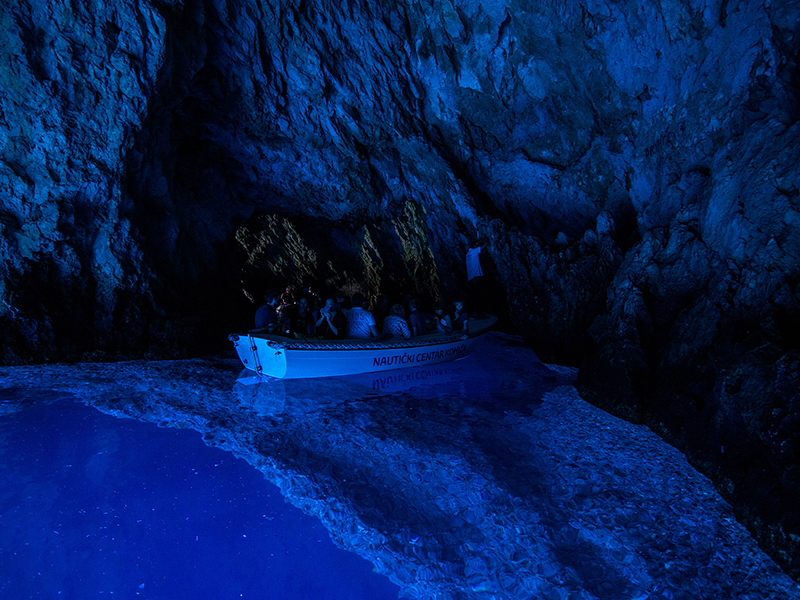
The Blue Grotto or Blue Cave, is a water-logged sea cave located in a small bay called Balun (Ball in the local dialect), on the east side of the island of Biševo and about 4.5 nautical miles (8.3 km) from Komiža, in the Croatian Adriatic. It is situated in the central Dalmatian archipelago, 5 km south-west of the island of Vis. The grotto is one of the best known natural beauty spots on the Adriatic and a popular show cave because of the glowing blue light that appears at certain times of day.
First described and painted by Baron Eugen von Ransonet, the cave was originally accessible only by diving as it had one natural entrance below the sea level. Based on his suggestion, an artificial entrance large enough for small boats was built in 1884.
The natural entrance to the cave, located on its southern side, is said to resemble a vault on the ceiling of a grotto. It is through this submarine-like opening on the ceiling of the cave that sunlight gets in and creates an iridescent blue glowing effect all around the cave. As well, a stone bar, connecting two walls of the cave, is clearly visible just below the waterline, both in above-water photographs and in underwater photos.
Vis is a small Croatian island in the Adriatic Sea. The farthest inhabited island off the Croatian mainland, Vis had a population of 3,460 in 2011 and has an area of 90.26 square kilometres (34.85 square miles).
The town of Vis is located in the north-eastern part of the island Vis in the bottom of a well protected bay. It developed from the former settlements Kut and Luka, which became one entity in the 16th century by the building of the church Gospa od Spilica.
Vis town and Komiža are also seats of separate administrative municipalities which cover the entire island and nearby islets, which are both part of Split-Dalmatia County.
Biševo is an island in the Adriatic Sea in Croatia. It is situated in the middle of the Dalmatian archipelago, five kilometers southwest of the Island of Vis. Its area is 5.8 km2 and it has a population of 15. In the center of the island there is a fertile field, the northern part of the island is covered with pine forests and the rest of the island is covered with maquis shrubland or bare rocks. The coastal sea belt is a rich fishing area.
Stiniva
One of the most beautiful hidden beaches on the Island of Vis is the beach Stiniva. It is located on the southern side of the coast near the village Marina Zemlja. To the beach you can get through the narrow path, so if you are not so skilled, you should take a boat to get to it.
Blue Grotto
The Blue Grotto or Blue Cave, is a water-logged sea cave located in a small bay called Balun, on the east side of the island of Biševo and about 4.5 nautical miles from Komiža, in the Croatian Adriatic. The grotto is one of the best known natural beauty spots on the Adriatic and a popular show cave because of the glowing blue light that appears at certain times of day.